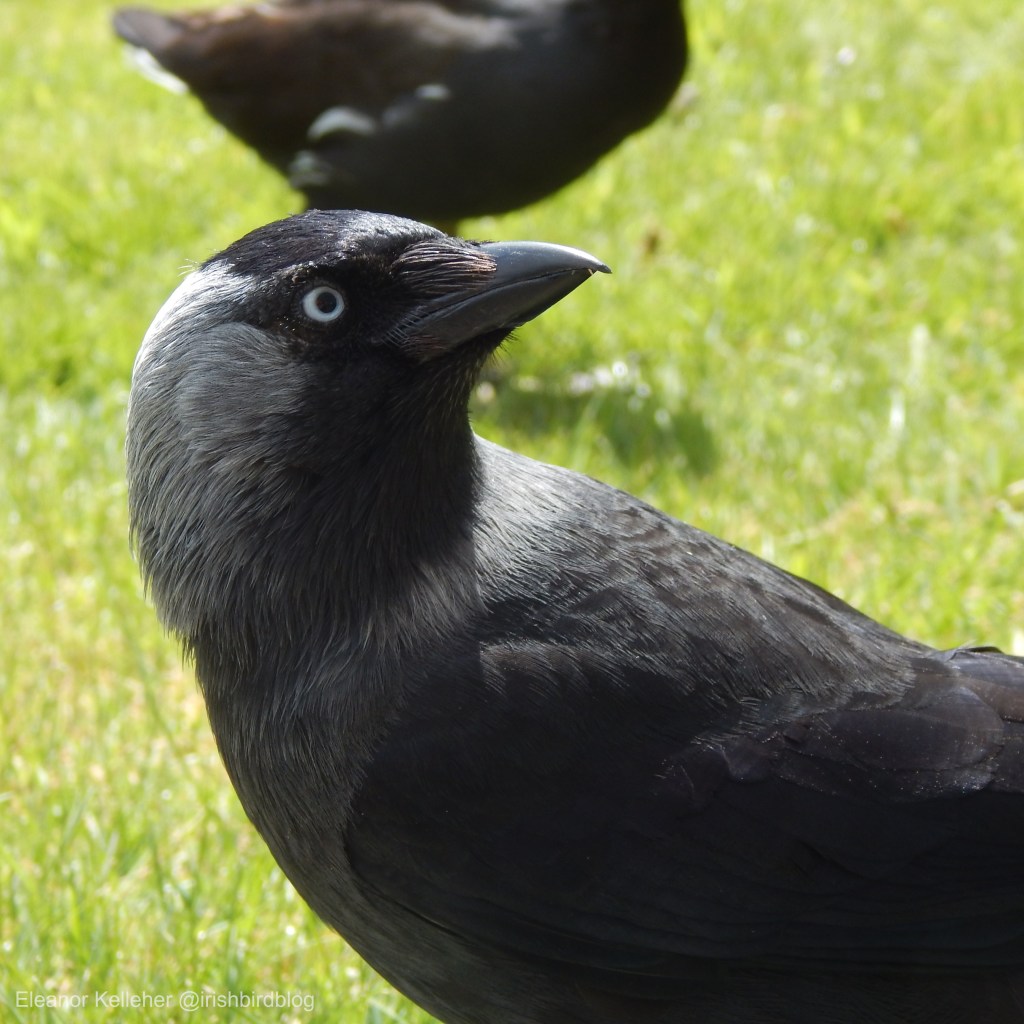
For many people in Ireland, the word “crow” is a catch-all term used to describe almost every black bird they see. This assumption is sometimes correct, since more often than not these birds do usually belong to the Corvidae family, of which the crow is a member. But this generalisation glosses over the unique traits each bird in this family possesses; the things that make them fascinating, intriguing, and worth learning about. One of such species is the jackdaw (Corvus monedula), known simply as the cág in Irish.
Lumping several birds together under one name isn’t a modern phenomenon. In Old English, most members of the Corvidae family were originally called either choughs, caws, or daws, all onomatopoeic spellings of their well known “caw” call. Over the centuries, each of these species garnered a nickname that would go on to become their common name. People began referring to one particular daw as a Jack daw, the nickname Jack indicating a “smaller form”. Two other birds we’ve talked about previously also received their names this way; the robin (once known only as the redbreast) and the magpie (previously called Margaret pie). Though their names have changed over time, human fascination with these marvelous creatures has remained constant.

The jackdaw might be my favourite corvid. Perhaps it’s their bright intelligent eyes; the subtle silver cowl that frames their face; or the fact that they’re renowned for their loyalty. Maybe it’s that they are just as comfortable picking through grassy fields as they are pecking at pathways on a busy street.
The fact that they are incredibly loving and devoted to one another is definitely a big factor. Jackdaws are known for their tendency to mate for life, forming strong bonds that last even after several unsuccessful breeding periods.

According to old myths and legends, jackdaws were once white instead of black. One of the gods (often Apollo) grew angry at the birds when he learned they had kept secrets from him and cursed them, resulting in their feathers turning black as tar. But not every jackdaw sports dark plumage; in fact, if you have seen such a bird with unusual speckled patches of grey or white feathers, you can count yourself among the lucky few who have seen a leucistic jackdaw.
The first time I saw a leucistic jackdaw, I was in primary school. My best friend and I had been given a special project that involved visiting each of the classes, which meant traipsing back and forth between the two school buildings. We started noticing a bird (we thought it was a crow) with white patches picking at the crumbs in the school yard after lunch time, and decided to name him Domino. We left food out (i.e. littered, but for a good reason) and told our other friends about him. He became something of a celebrity amongst our friend group for the rest of the school year. Even now, ten years after that, I still look at leucistic jackdaws and wonder if it’s our Domino.

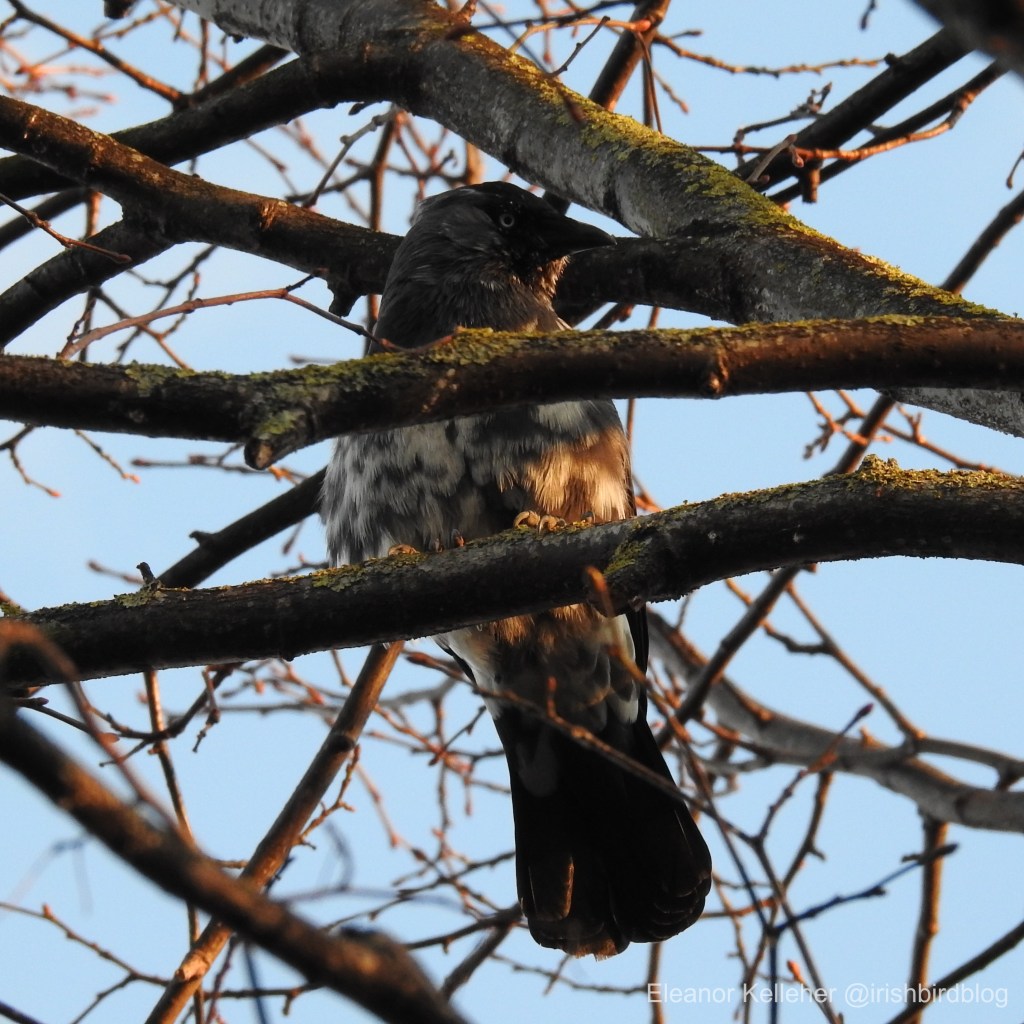
Leucism affects a bird’s feathers, typically the ones with melanin pigment, usually dark feathers. This differs from albinism, which is a total loss of pigmentation in feathers, skin, and eyes. Across different avian species, leucism and albinism occur at varying rates. Jackdaws are among the birds with the highest reported frequency of leucism, along with house sparrows and blackbirds.
This could be due to the fact that their feathers are darker than the average bird’s, but it might be due to their long lives. Just as our hair turns grey as we age, bird feathers too become lighter as they get older, or so it’s believed. It stands to reason that these smart birds have a longer life expectancy than other birds do, in fact, the oldest known wild jackdaw was recorded to be just under twenty years old!
If they can manage to live so long, is it any wonder their feathers begin to show their age?
So, if you happen to spot my old friend Domino out there, I’d love it if you left out some crumbs for him.
 The Irish Bird Blog
[…] feral pigeon has a HUGE range of plumage patterns, and are very prone to leucism! As well as differences in feathers, their eyes can also vary in […]
LikeLike