
To close out the year, we thought we’d talk a little bit about one of our resident birds who sings all year round – even in winter! They may be quite small, but their voices are anything but! This month’s bird – and the last bird of 2022 – is the wren (Troglodytes troglodytes), known as Dreolín in Irish.
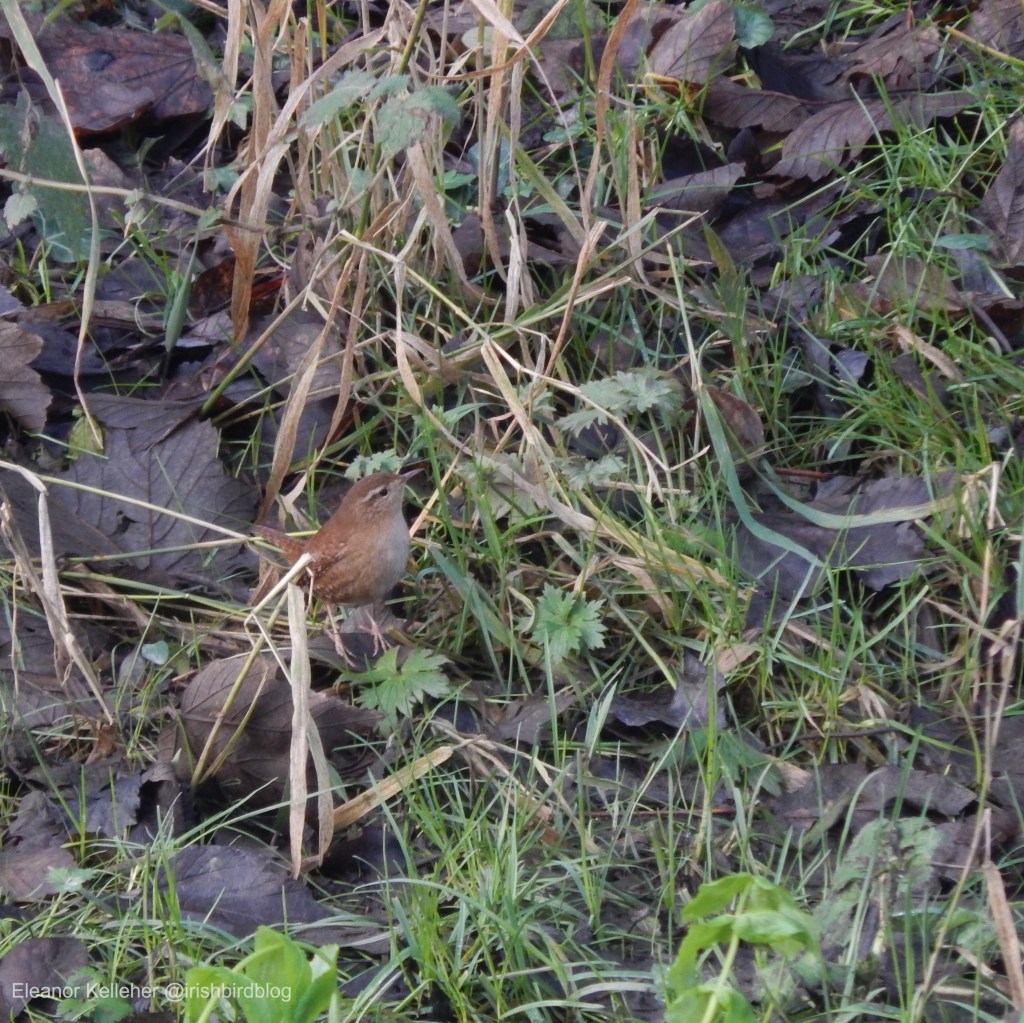

You’ve almost definitely seen a wren before, considering how widespread they are. There is a total of eighty-eight species in the wren family, whose range spans the entire globe. The Eurasian wren (the species that can be found here in Ireland, and the one we are talking about today) was the first wren to be named, and is the only wren to exist in the “Old World”, with all others inhabiting the Americas and Oceania.
Wrens are tiny birds that are as long as a playing card and weigh about as much as two teaspoons of sugar. If you’ve ever seen a small brown shape dart across your path or seen a little dark figure flitting about the branches of a tree, it was most probably a wren. They’re notoriously fast, which, speaking from experience, makes them quite hard to photograph.
But if, somehow, you haven’t managed to catch a glimpse of them, you have surely heard their call. For their small stature they certainly pack a loud volume, with over three hundred “syllables” expelled in one two-second call!

One of the reasons why we wanted to talk about wrens this month is because of the festivities that are held on the 26th of December for Wren Day.
Wren day originated in Ireland but has spread across the water to the continent, where a number of European countries also celebrate it. The tradition involves “hunting” a wren (which used to be a live wren, but has since been replaced by a fake one), attaching it to the top of a decorated pole, and parading through the streets. The crowds who participate are known as wrenboys, and they dress up in masks, straw suits, and colourful motley clothing to go door-to-door to collect money. There is a song the wrenboys sung whilst going from house to house. It has many variations; here is one that is sung in Edmondstown, in county Dublin:
The wren the wren the king of all birds
St Stephen’s Day was caught in the furze
Her clothes were all torn- her shoes were all worn
Up with the kettle and down with the pan
Give us a penny to bury the “wran”
If you haven’t a penny, a halfpenny will do
If you haven’t a halfpenny, God bless you!
The origins of the day are also debated, but the commonly believed myth in Ireland is that God wanted to know which bird would reign supreme over all other birds. So, he devised a challenge: the bird who could fly the highest and furthest would be crowned king. All birds began at the same starting position, but eventually dropped out one after the other until only the eagle was left. When the eagle grew tired and began to drop lower in the sky, the wren was revealed to have hidden on the eagle’s back and took flight, soaring higher and further than all the others. For this reason, it is known as the king of birds, a sentiment that is reflected in the Wren day song.


Wrens are such charming little birds, I’m so happy we get to see them all-year round. They’re almost comically tiny, but their iconic pose with the cocked tail really does harken to a sense of nobility befitting the king of birds. Hopefully their big booming songs will help us get through the last of these cold winter days. Happy holidays from the bird blog, we hope to see you again in 2023!
 The Irish Bird Blog