Can you believe we’re already into the second month of the year? February has risen above the other months of the year for me since we gained that extra holiday in Ireland, but it still feels like a relatively quiet month. To jazz up this dull period, we thought we’d write about a bird of prey – the first to be featured on the blog! These birds are sharp, elegant, and also happen to know a thing or two about rising above their peers (physically and metaphorically!). This month’s bird is the Common Buzzard (Buteo Buteo), known as Clamhán in Irish.

I’m a big fan of Latin names that just repeat the same word twice and this one also has some interesting lore attached to it. In the New World (the USA and Canada) birds in the Buteo genus are called hawks, and can be collectively referred to as buteos rather than buzzards. People from the US and Canada colloquially use the word “buzzard” to refer to vultures, because back when settlers first moved over, they assumed those large, circling, birds of prey must’ve been the same birds as the buzzards back home – even though they don’t look anything alike. We know now that they’re different birds, yet the misnomer still persists. If I were a buzzard, I’d hate to think that anyone thought I was related to vultures because those birds are super uggo, and it’s okay for me to say that, because this isn’t a blog about American birds.
Another word that’s commonly used to describe birds of prey is raptor. Raptor comes from Latin and means to seize or to plunder. It’s an apt description, since that’s what these birds will do when they come swooping down, so look out!

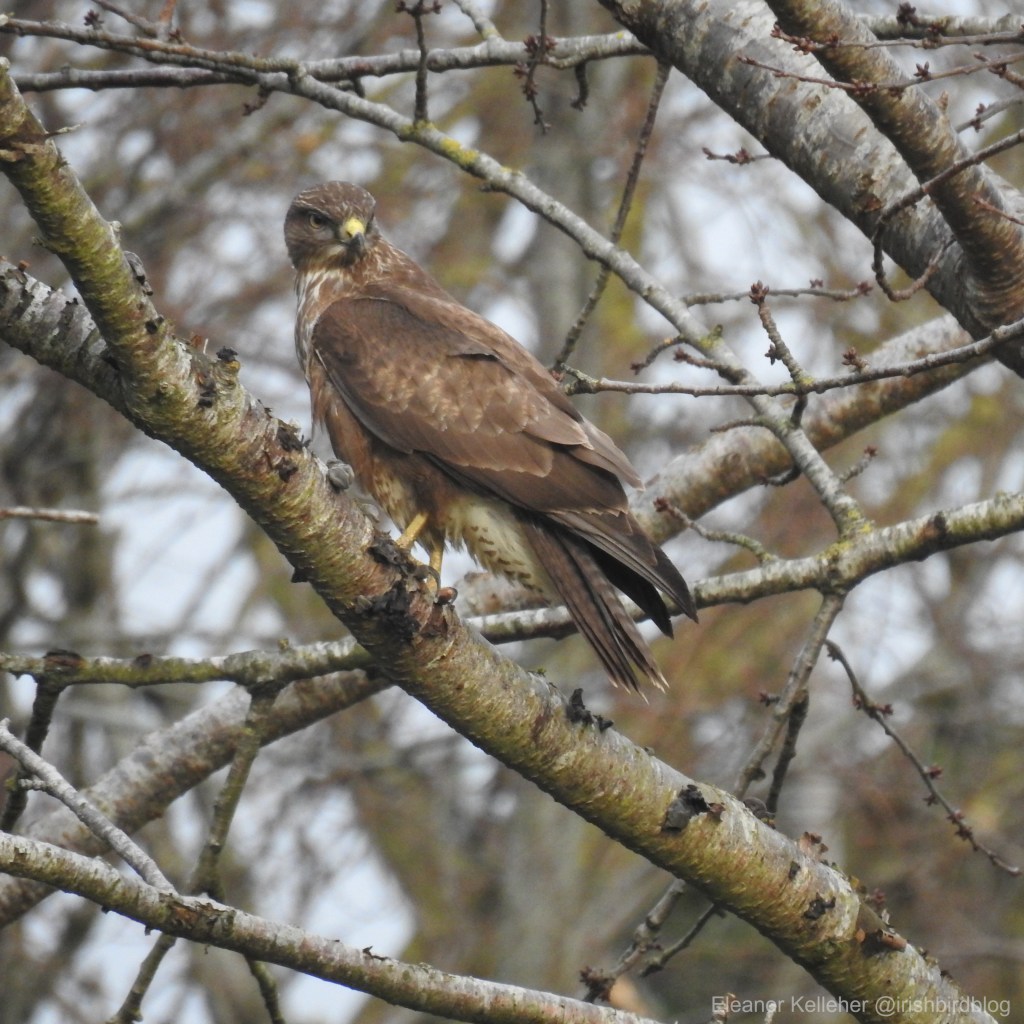
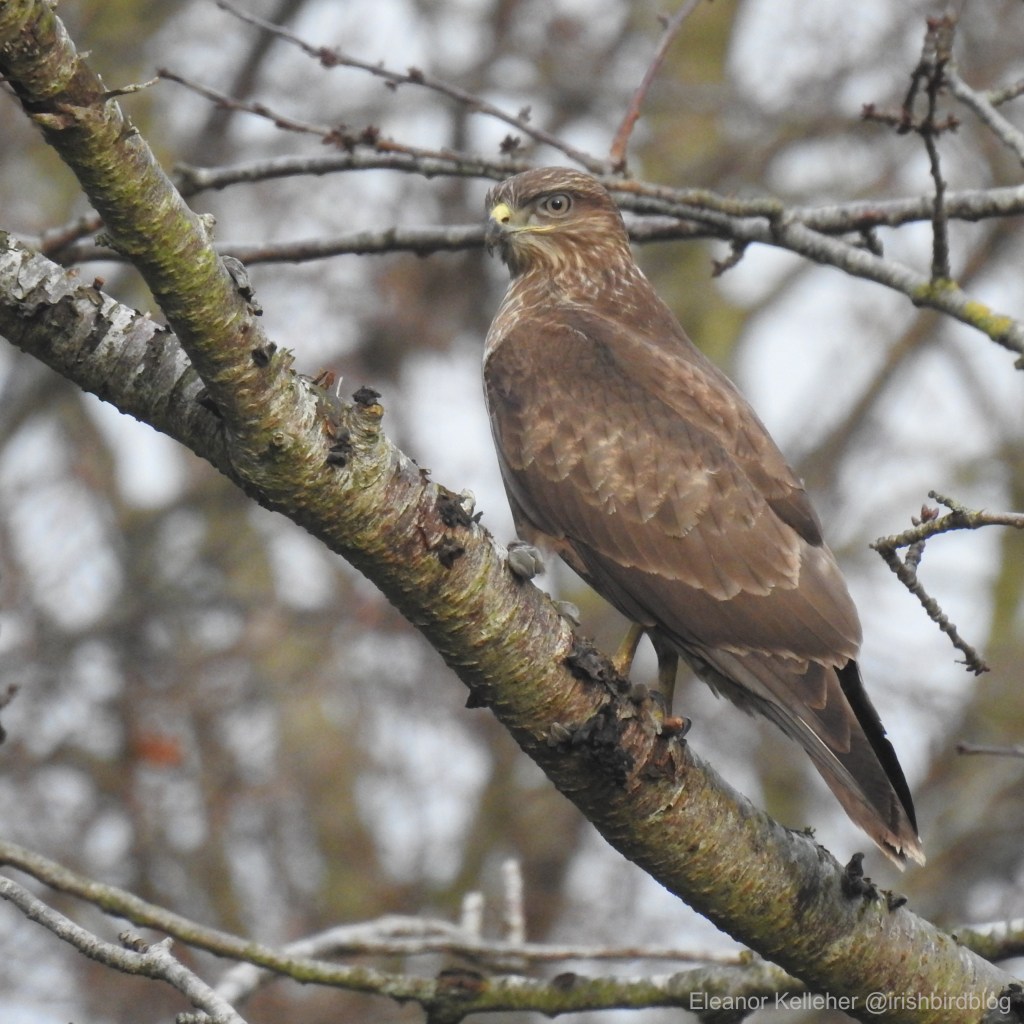
The first time I saw these birds in person was actually in February of last year. I was on a health kick so I woke up three hours before work, got dressed in the dark, and braved the frosty spring morning to go on a walk in a nearby park. It would have been a peaceful walk, if not for the racket that the birds were making. Magpies, rooks, jackdaws, all were bellowing out these ear-shatteringly loud calls – sounds I don’t think I’d ever heard them make before. As I walked up a hill, I saw the reason why they’d gotten their tail feathers in a twist: a huge brown bird was being chased away from a tree by a band of over-zealous magpies. I’d never seen a bird like that before so I took off after it, hoping to get close enough to see some notable features so I could ID it later. But no matter where this bird went, the corvids followed, chasing it all over the gardens. I ran up and down hills, my nose running, holding on to my beanie with one hand to keep it on my head.
After running down my third or fourth hill I paused to catch my breath, keeping a close eye on where I saw the bird fly to last, when another one soared silently over my head. There was not one, but two buzzards flying around the gardens, and I, being the fool that I am, must have been chasing both of them and failing to get close to either. I lost them both soon after, but was excited to go home and flick through our birdwatching book to see what rare bird I’d encountered. We assume there must have been a buzzard nest nearby, and since then we’ve often caught sight of one flying up and down the nearby river or perched in the trees surrounding its banks.


Buzzards are spoiled for choice when it comes to their prey. They’ll go after other birds, small mammals, like rabbits; insects and earthworms, and even amphibians. But their most common meal usually consists of small rodents. They’ll also feed on carrion but that’s proven to be a fatal choice (we’ll talk more about why later in the article).
As skilled predators who are un-picky with their food choices, the presence of buzzards in an area indicates a healthy habitat. John Lusby of BirdWatch Ireland writes:
“As top predators, buzzards are excellent sentinels of the wellbeing of the environment…Their re-colonisation has restored a natural balance, filling a vital ecological niche which has been empty for decades. By feeding readily on carrion, and through direct predation, Buzzards help to keep numbers of corvids such as Hooded Crows and Magpies in check.”
In fact, the reason we have so many corvids in this country is because we drove predators like the buzzards to extinction. So what happened to buzzards to wipe them out and how did they bounce back?
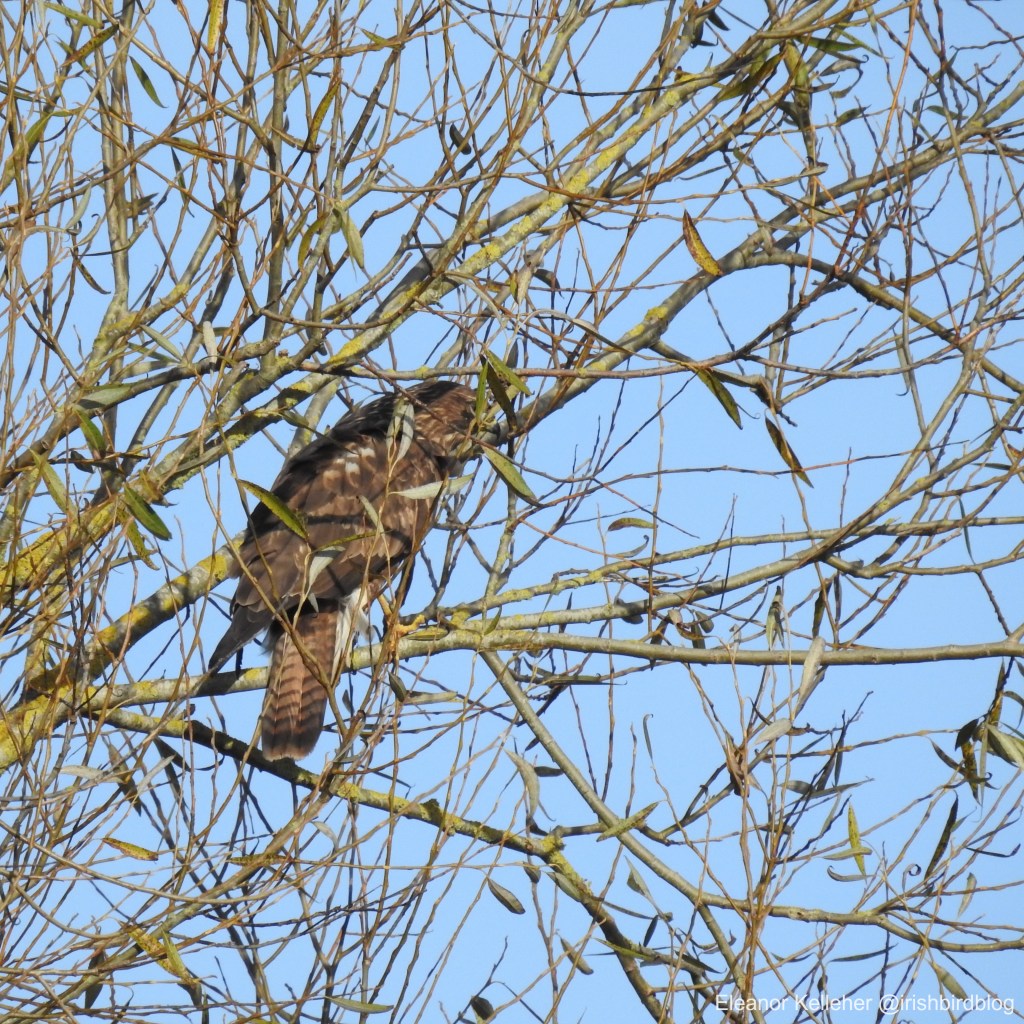


At the start of the 20th century, a number of birds of prey were hunted to extinction in Ireland. This includes the golden eagle, the white-tailed eagle (also called the sea eagle), the red kite, and of course, the buzzard. They weren’t killed for their meat or for sport, but because many people erroneously thought they were a threat to livestock, an antiquated notion that still somewhat persists today. While the other three species on that list have had to be manually re-introduced to this country, the buzzard took matters into their own claws.
The last native buzzard was wiped out in the 1890s. For four decades this island was buzzardless, until a small group of them migrated over from Scotland to Co. Antrim in Northern Ireland and started breeding. Another wave of raptors in the 60s and 70s was enough to establish a steady breeding population, but the birds never moved south of the border into the Republic of Ireland. The reason for this was simple: strychnine.
Strychnine is a potent poison that was used to kill vermin, such as foxes, badgers, and corvids. As I mentioned earlier, buzzards will happily feast on carrion, unaware of the poison that’ll end up killing them as well. Strychnine was banned in the UK for a long time but a ban on its use in the Republic was only introduced in 1991. Once this ban came into effect buzzards slowly began moving south, sticking mainly to the east coast, though there are reports today of them moving westward. Soon enough, they’ll probably return to their former range across the island – a major win for Irish birds and the Irish ecosystem as a whole!
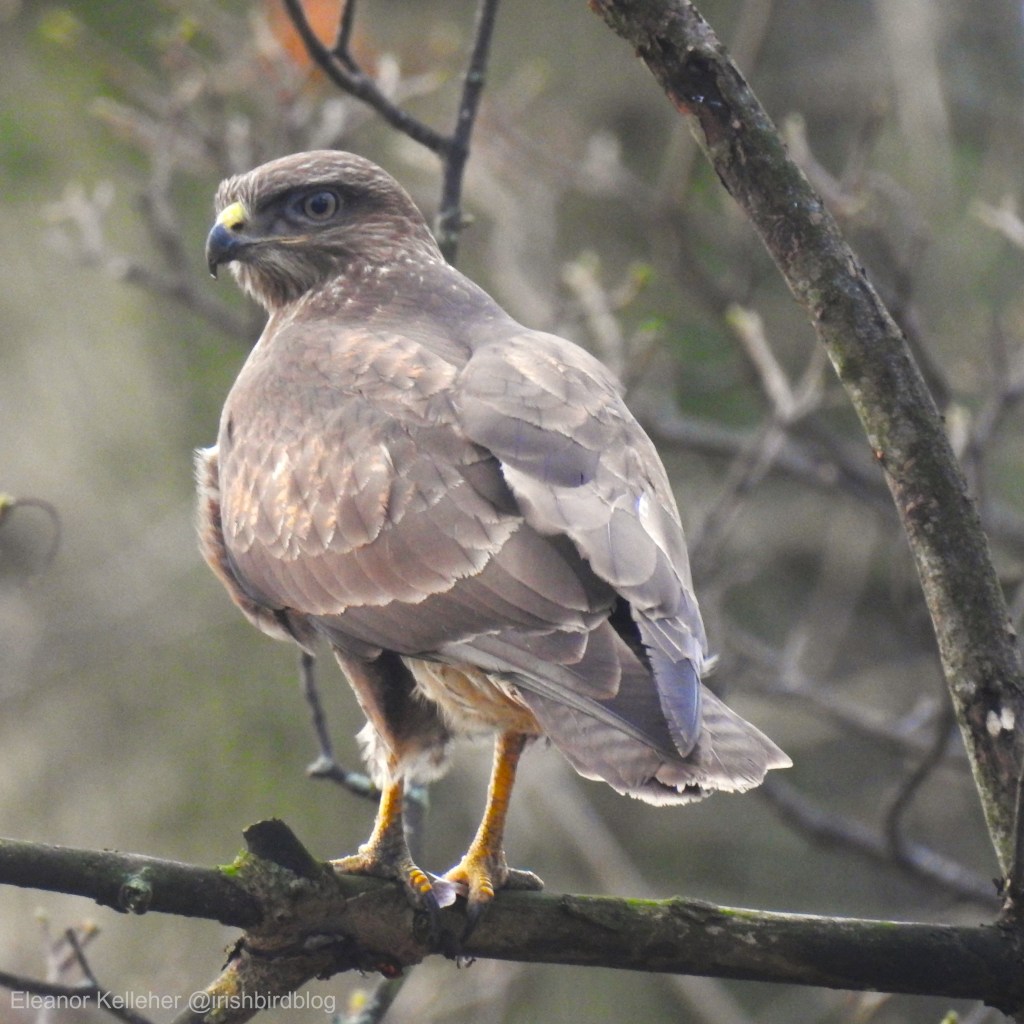

The Buzzard population is showing the greatest increases in distribution and abundance of any bird species recorded by the Breeding Birds Atlas in Ireland over the past 30 years! While not all species reintroductions can be this easy, this is a great example of how a small change like banning a specific chemical can go a long way in restoring the natural balance. I hope you’ve enjoyed this success story, because next month we’ll be talking about a bird who hasn’t had the same good fortune that buzzards have had. But that’s for next month, today let’s rejoice in the resilience of one of our sharpest birds and their unexpected comeback.
 The Irish Bird Blog
Greay article, in the last few months alone I have seen several buzzards in Mayo and my dad saw one in Sligo today.
LikeLike
[…] to share this rare occurrence with you. You’d think that the fact we’ve only written one other bird blog about an Irish Bird of Prey (IBOP, unofficial acronym) would mean that we write about […]
LikeLike
Great article. Theres plenty of these guys near us. Three were born at Ward Golf Centre last year, and have stuck around the area even though their nesting tree at the back of the field was downed by Storm Eoin. You can see them floating over the M2 and R135 from Finglas up to Ashbourne. Plenty of pidgeons getting ripped apart in the last few weeks out on the field. Not a few of their remains end up in the ball collector machine. They are keeping the rabbit population down too, and some very healthy looking foxes moved in recently to lend a hand. Probably down to 60 rabbits now from about 120 a few years ago. Its quite addictive following the Buzzand and their distinctive call can be heard at least a km distant, so, quite piercing, compared to other birds.
LikeLike
Great article. Theres plenty of these Buzzards near us. Three were born at Ward Golf Centre last year, and have stuck around the area even though their nesting tree at the back of the field was downed by Storm Eoin. You can see them floating over the M2 and R135 from Finglas up to Ashbourne. Plenty of pidgeons getting ripped apart in the last few weeks out on the field. Not a few of their remains end up in the ball collector machine. They are keeping the rabbit population down too, and some very healthy looking foxes moved in recently to lend a hand. Probably down to 60 rabbits now from about 120 a few years ago. Its quite addictive following the Buzzand and their distinctive call can be heard at least a km distant, so, quite piercing, compared to other birds.
LikeLike
thank you for the insightful article!
I live in an area of cavan where we’re fortunate to have them circling around in the skies regularly.
Alex
LikeLike
[…] remain unseen: they are experts at mimicry. In Ireland they regularly copy the mewing call of the buzzard. But they’ve also been known to mimic cat meows or dog barks to confuse these animals and […]
LikeLike
i spot at least three buzzards every day perched every couple of kilometers between corkagh park to Newcastle road Lucan. They’ve become so common you can recognize each bird by size and colours . They’re was red kites in the area this summer for the first time but they’ve moved on. Very easy to spot in winter when you know their favorite perch. 30 years ago I never seen one. So I think they’re benefiting from all the extra road kill around the expansion of business parks.
LikeLiked by 1 person