
Second late birdblog post in a row, a new record that we’ll try hard not to break. Summer is definitely in full swing, as evidenced by the bursts of colour I’ve been seeing across people’s gardens. The world is so bright, I have to wear sunglasses every time I step outside to avoid squinting – luckily for me they’re current-weather appropriate. This heat has me feeling tired and lazy, so let’s take a moment to cool down with this month’s bird. Their icy-white plumage is easy on the eyes and their tranquil vibes are sure to help you chill out. This month’s bird is the Little Egret (Egretta garzetta), known as Éigrit bheag in Irish.

Do these birds remind you of anyone? Like, if you had to think of this bird’s ugly cousin, would the grey heron be a contender? Because as it turns out, they’re both members of the heron family! In fact, their genus name comes from the Provençal French word aigrette, which is a diminutive of the French word aigron, which means heron.
I know we shouldn’t anthropomorphise but I can’t help but see little egrets as put together and grey herons as sleazy greasers. They both have long feathers (or plumes, if you’re fancy) growing on the tops of their heads at certain times of the year, but somehow the little egret just does a better job of rocking them; the grey herons’ always reminds me of rat tails.
Sorry, I’ll stop bagging on the grey heron. Let’s celebrate the beauty of little egrets instead – though they have the same proportions as their cousins, they are about half their size, only measuring up to around 55cm tall and half a kilo in weight. Their beautiful white feathers always make me think of angels wings, even more so than swans’ do . There’s something very ethereal about them; looking out across the water on an overcast day and seeing an elegant figure of white gently picking its way over before taking flight on silent wings.



It’s unfortunate that there aren’t any myths solely attributed to little egrets. Since herons, cranes, and storks have all been lumped in together throughout history it’s hard to tell what bird a legend is actually talking about.
We know that, historically, little egrets were present in Ireland and Britain (they were noted to have been part of King Henry VI’s coronation feast in 1429), but a couple of factors caused their decline over time. Cooling temperatures forced them to search for warmer climates to breed in, while over-hunting eliminated the birds who didn’t get out fast enough. Strangely, it wasn’t just the meat that hunters were after, it was their feathers too. Remember how I said these birds have gorgeous plumes on the top of their heads? Well, it turns out people in the 19th century thought so too.
Their feathers had been sought out since the 17th century but 200 years later a craze began to sweep across Europe: You were nobody if you didn’t have a fancy feather sticking out of your hat. Cruel and unusual farms were established to keep the birds so that their feathers could be taken without killing them, but the demand was simply too great. The number of egret skins passing through dealers hands reached the millions. The killing of wild egrets got so bad that it actually prompted the establishment of the Royal Society for the Protection of Birds in 1889 in the UK.
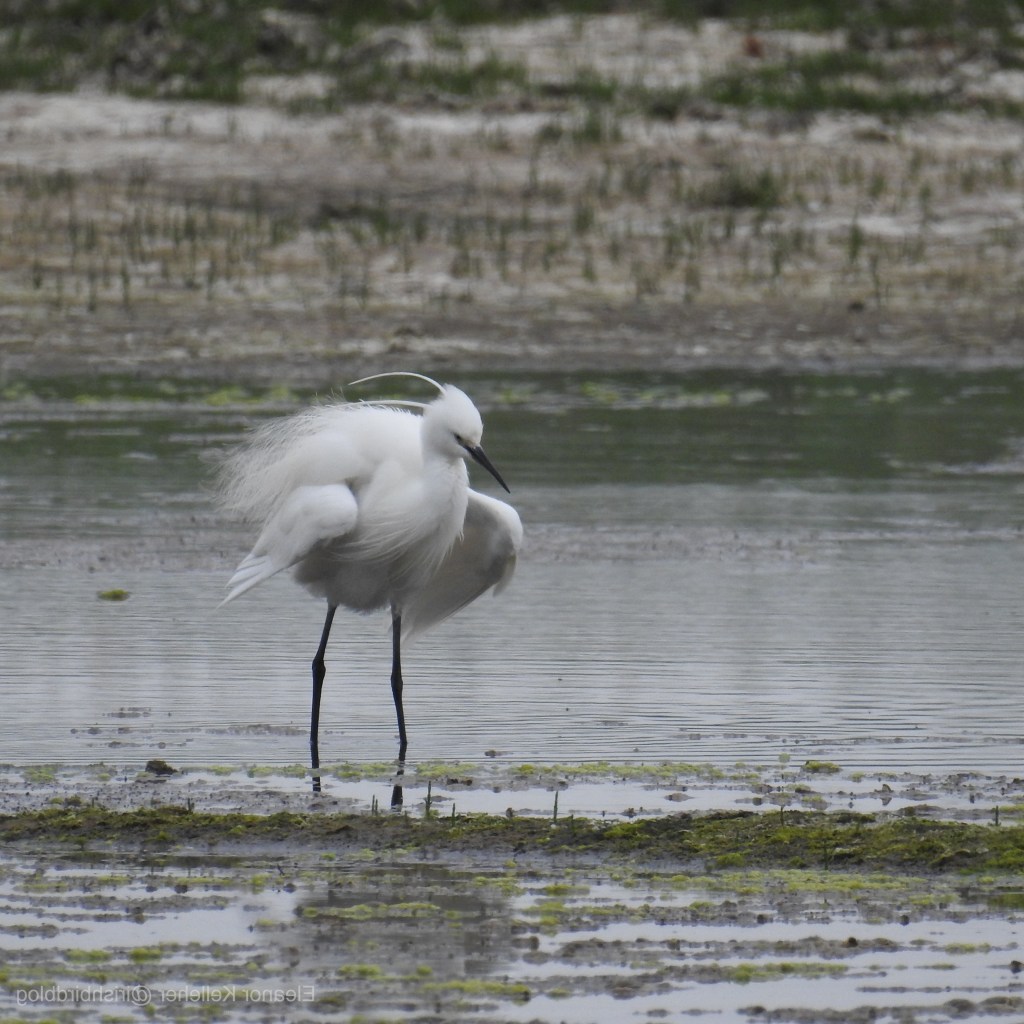

Thankfully, their numbers have come bouncing back since then. Little egrets were considered rare visitors in Ireland until our first breeding pair was confirmed in 1997, and now you’re likely to see them in every coastal county as well as a few inland ones, even in winter. Despite our cold climate they seem to manage just fine, though they prefer warm weather – outside of Ireland you can find them in sub-Saharan Africa, across Asia, and even in the vast majority of Oceania. They’ve been expanding northwards and also across to the New World – in 1994 they were confirmed to be breeding in Barbados in the Caribbean.
They breed in colonies consisting of other little egrets, but also other bird species. These birds don’t discriminate, there’s safety in numbers so everyone’s welcome. A wide open space is best for a colony, since you can see predators from a while away. To that end, rice fields are important habitats for them in Italy, while coastal and mangrove areas are important in Africa. Little egrets will build nest platforms out of reeds or sticks in bushes, trees, or reed beds – standard bird stuff.


Little egrets are very adaptable birds – which explains their newfound range. They can adjust their food habits to suit the location their in, and are opportunistic and clever. For example, they learned that humans throwing breads may attract fish, so they wait on the sidelines with some bait and pounce when the time is right. They can also sometimes be seen following cormorants because they know that their presence may disturb fish into revealing themselves.



Summer is a good time to see these birds, so the next time you’re out for a beach swim, see if you can’t just spot the long plumes of an elegant little egret on the horizon.
 The Irish Bird Blog