Happy April, happy Earth month! Veteran readers know that we here at the Bird Blog are all about putting the spotlight on Irish birds, who desperately need our help in combating the effects of climate change. But birds are part of a wider ecosystem, whose other members could also use some time in the public eye. So, in honour of Mother Nature’s birthday, we are bringing you an article that talks about more than just a bird, and the warning signs on the horizon for the entire food chain. This month’s bird is the Tufted Duck (Aythya fuligula), known as Lacha bhadánach in Irish.

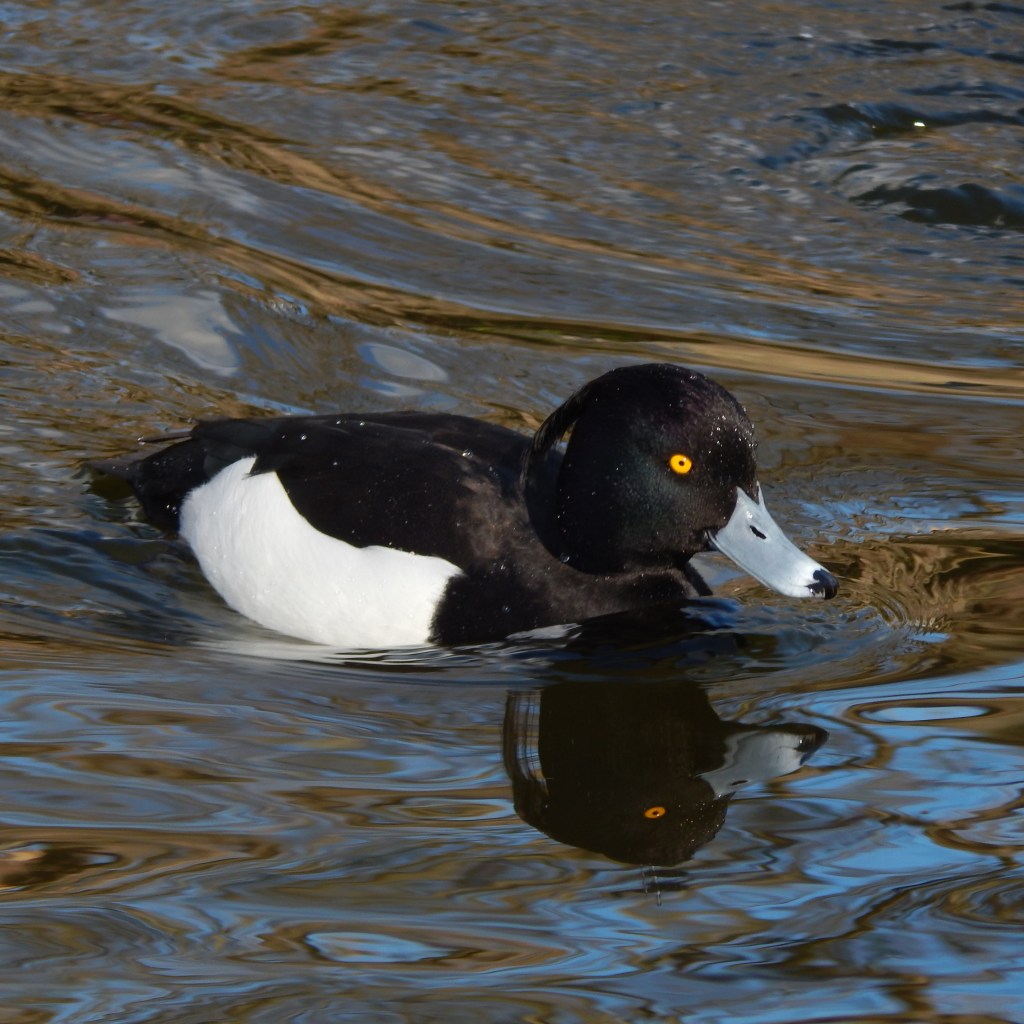
Sitting on a bench overlooking a pond, you idly take note of the usual suspects floating there. Mallards, of course, chasing a toddler wielding a slice of week-old bread, and the various gull species squabbling over sodden crumbs. Amongst the cooing pigeons and the graceful swans, you spot a conspicuous stranger in the crowd. Danny Zuko eat your heart out because zooming-on over is a T-bird with wickedly slicked black hair, a bill so blue it puts denim to shame, and a bright golden eye that looks like the summer sun.
Does this bird seem familiar? I wouldn’t be surprised if it does, tufted ducks are our second most common duck, relatively speaking, especially in winter when we get an influx of migrants. For any of our North American readers (hello, how did you find us?) this bird resembles a scaup, a small number of whom also grace our shores in winter, so if you’re going out looking, don’t be fooled. The easiest way to tell them apart is to look at their hair – the scaup has a perm and our tufted duck has their iconic “tuft” cresting the top of their head.
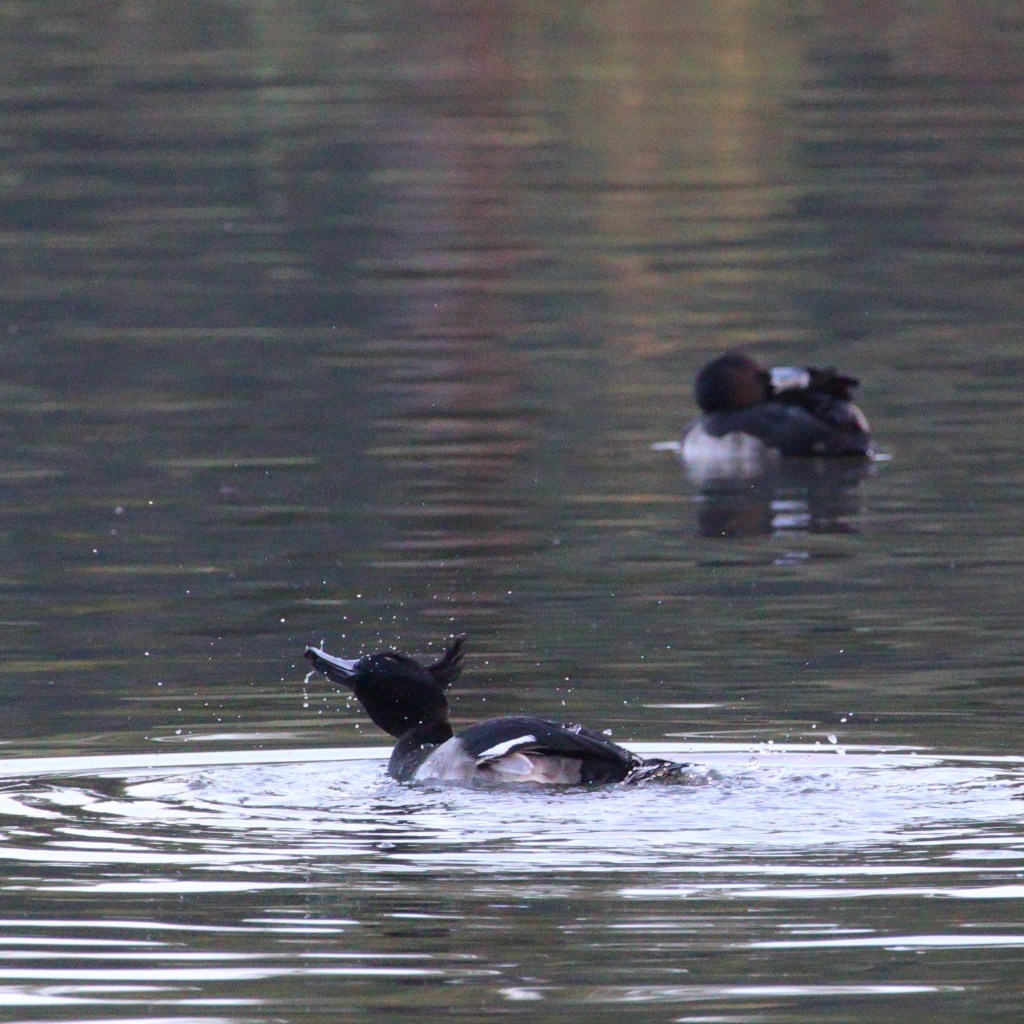

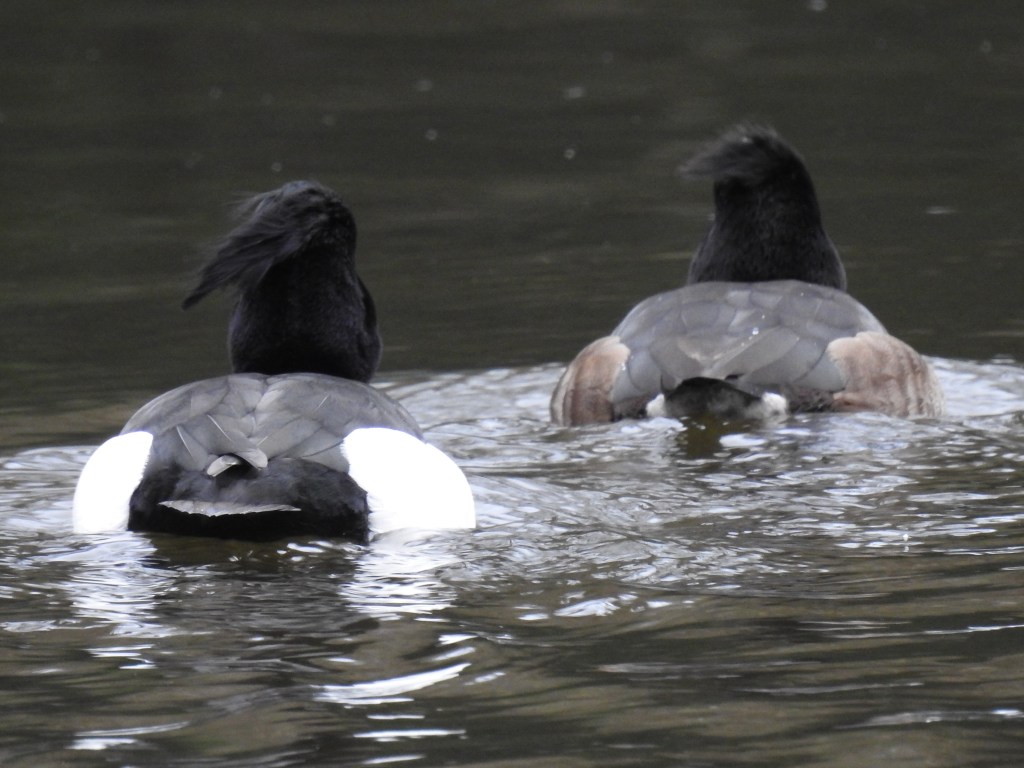
Like a Pompadour in the 50’s, this bird’s tuft is an iconic look – so much so, that their Irish name is a 1:1 match to their English name (badán is the part that means “tuft”). It’s unfortunate that their Latin name doesn’t follow suit: Aythya comes from the Ancient Greek Aithuia, an unidentified seabird mentioned by the likes of Aristotle in their writing. Fuligula means “sooty throat”, most definitely referring to the inky black sheen of their feathers, as the sound that these birds make is nothing like the throaty quack of a mallard. To me, it sounds really watery, like the noise that would accompany a bubble animation.
Unlike Greased Lightning, tufted ducks aren’t great fliers on account of their short wings. You’ll see them burning rubber as they try to take off, flapping and dashing across the surface of the water to build up momentum to take to the skies. That being said, some populations of these birds are globetrotters that migrate between eastern Europe and Africa, and north and south Asia. Our temperate climate suits these birds year round, so you’ll be able to find them regardless of the season. (I recommend checking St. Stephen’s Green Park in Dublin, there’s always a few milling around!)

So these birds may not be going to that malt shop in the sky, but they’re far from duckie dropouts. You won’t find these ducks dabbling – their talents lie in diving deep under the water, a nifty tactic to evade predators and find some grub. They dine on crustaceans, insect larvae, and bryozoans (I had to look that last one up and I can best sum it up as a beige lump of animal), but their favourite food is bivalves, like mussels.
Tufted ducks, like most other ducks, are considered a game bird and hunted for sport in Europe (boo!) but their tendency to scrape around on the riverbed for food has resulted in their meat tasting “muddy” and undesirable. An unintended consequence of dodging natural predators, you can also escape the unnatural ones.
And speaking of bivalves, let’s talk about the not-so wonderful world of freshwater mussels. Tufted ducks and other birds need to eat, obviously, to sustain themselves. But their prey are important creatures in their own right, and the tufted ducks’ meal of choice happens to play a really important role in nature.


Freshwater pearl mussels are a critically endangered native bivalve that can grow to be over 50mm in length and live for up to 140 years, making them the longest lived Irish animal. Their population declined by over 90% in the 20th century across Europe, and in Ireland their scarce numbers are dwindling even further. One reason for this is the pearl trade, where thousands of mussels are killed in the hope of finding a single measly pearl. Despite legislation in Ireland that bans the practice, there is still evidence that illegal fishing occurs. This can sometimes be perpetrated by fisherman from other countries, where the punishment for pearl fishing is a lot harsher. Another threat is invasive mussel species, like the zebra or quagga mussels, which can breed quicker than our natives can and who attach themselves onto our native mussels to suffocate and steal food sources from them.
As sad as it is, why should you care? Well, freshwater pearl mussels are only found in pristine waterways, and they themselves contribute a great deal to cleaning them up. Anchored to the riverbed, they filter vast quantities of water through siphons that catch bacteria and other microorganisms. They do such a thorough job that we could probably drink that water if we needed to. When the water is unclean or if there’s too much silt or algae, the mussels have a harder time doing their job. Juvenile mussels especially are more sensitive to pollution and will suffocate because they cannot get enough oxygen when they’re being subject to algae blooms and sediment. Mussels disappearing due to fishing or over-competition with invasive species, means less mussels around to filter the water, which means the water quality gets worse, and that means the remaining mussel population perishes. Our waterways turn dank, and other species that rely on the mussels for food – ducks and some fish – then begin to decline and eventually vanish themselves.

A year ago, I happened to stumble on an article that listed all the species that had been declared extinct in the previous year. After reading through the list of birds and mammals with a sinking feeling, I got to the list of invertebrates. Scrolling through all the mussels, I couldn’t help but wonder who was out there mourning these poor creatures – unlike the tufted duck, the freshwater pearl mussel is hardly seen and lacks the charisma to garner sympathy. Yet they play such an important role and even if they didn’t, the world needs variety, diversity makes everything more vibrant. Who doesn’t love that sense of intrigue and wonder when they spot a bird that’s out of the ordinary perching in their garden? So while I hope you enjoyed reading about the tufted duck, I also hope you’ll spare a thought for the freshwater pearl mussel, and all the other little creatures that help make our world go ’round.
 The Irish Bird Blog