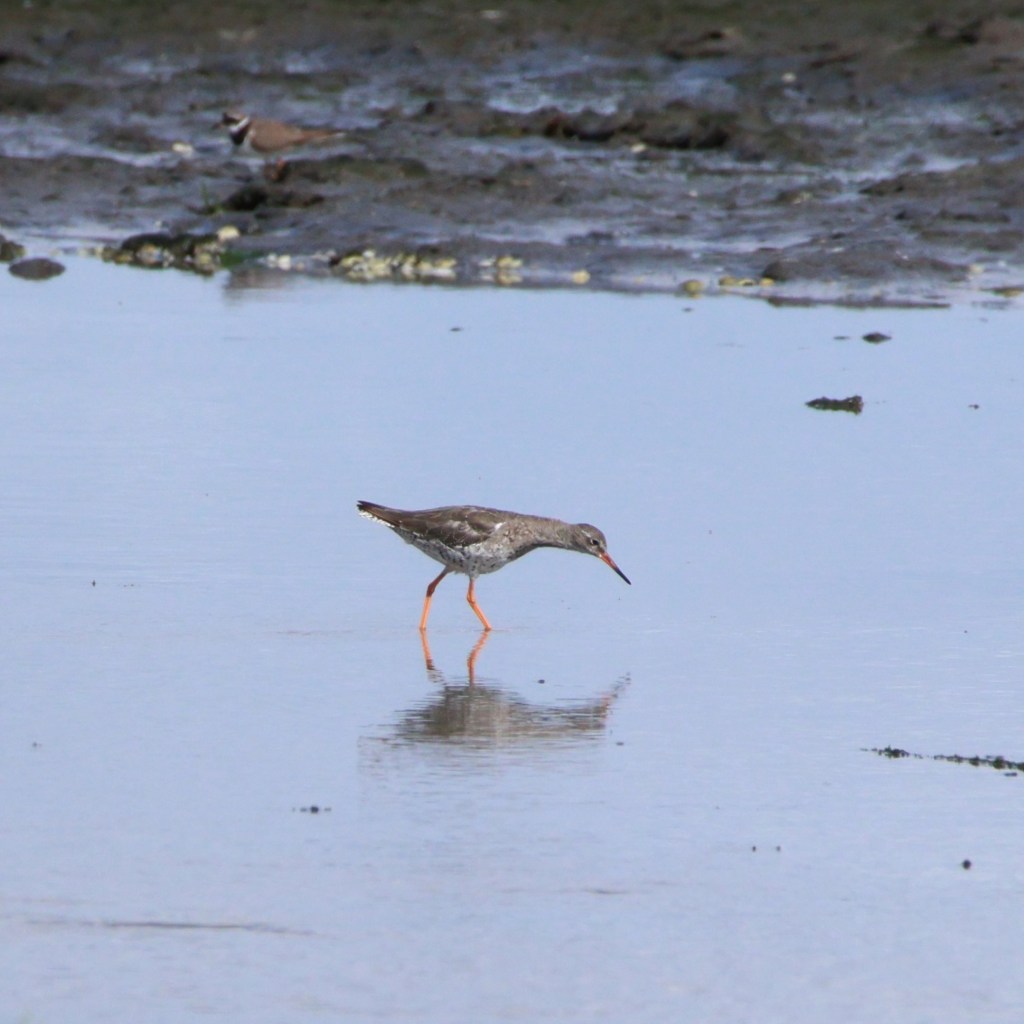
Welcome to the liminal space between Halloween and Christmas; where the only assured thing is hearing people complain about how dark it gets by 4 p.m.. It’s a moody, introspective time, quiet in the wake of one big holiday and anticipation of the next. I think we need something bright to carry us through these dreary days. Nothing too big or bold, and it has to help us keep up our momentum to the end of the year. Fortunately today’s bird fits the bill (and also like to fit its own bill (into the sand)). This month’s bird is the (Common) Redshank (Tringa totanus), known as Cosdeargán as Gaeilge.

You shuffle as close to the stone wall as you can to let passerbys make their way down the pavement. Some opt to just walk on the cycle path, glancing in wonder at the group of people huddled in coats, scarves, and gloves as they go. Binoculars are raised, pens scribbled in the corner of a notepad before ticking a name off a list. Chatter about how the weather is good today but not great for photos. Peering across the small wetland area, your eyes start to adjust to the mirror-bright shine of the water reflecting the grey skies above. An island hunched in the mire is bisected by a little muddy trail. Tufts of dry grass, old and stubbly, stick out of its peaks. The wind whistles through the bare branches of trees lining the area. Then you blink and something clicks, and you realise there are dozens and dozens of little birds running around in the shallow water. Their bright legs flash like motes of fire as they pick their way from one side to the other. Safety in numbers, the swarm of calls to each other; a twittering chirp that silences the crowd around you.

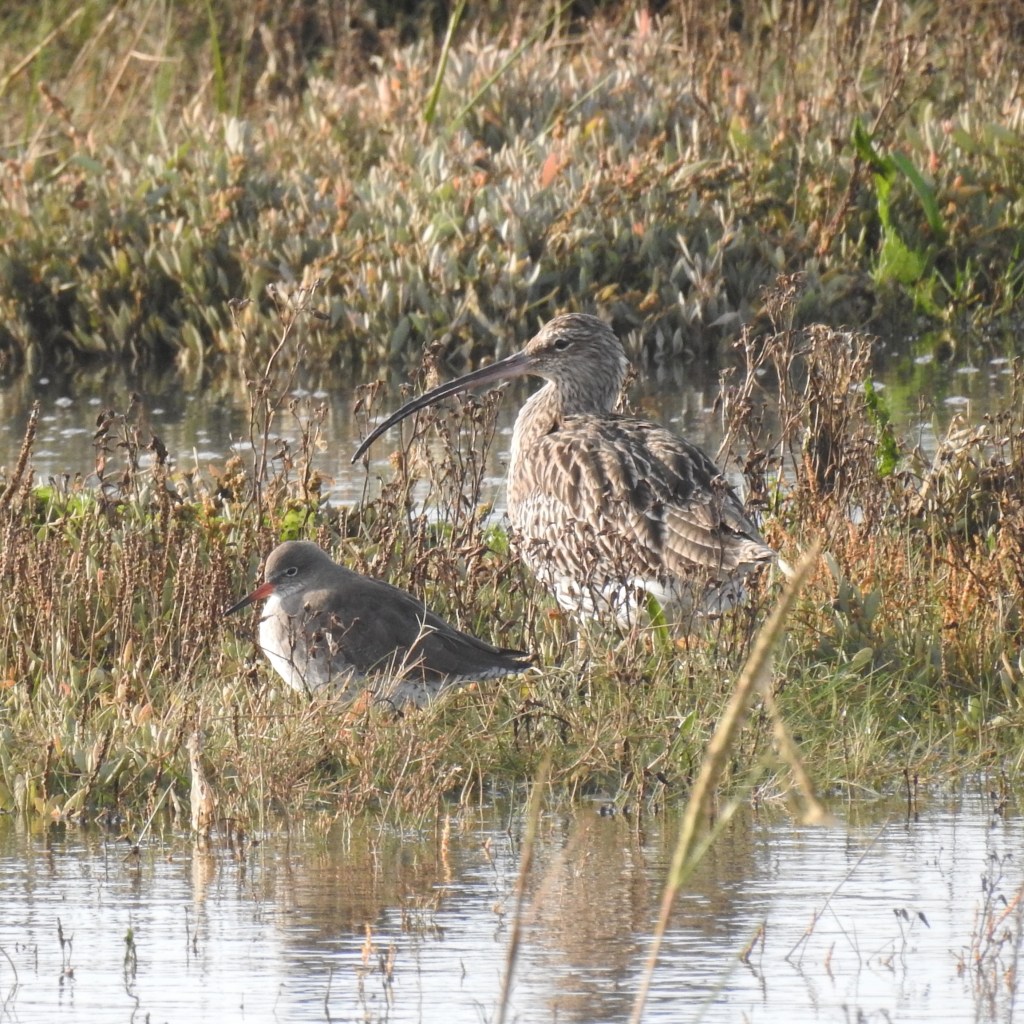
The first time we encountered redshanks, we couldn’t tell the difference between them and a number of other birds (like their cousins, the greenshanks). We were part of a birdwatching group event that met at Booterstown Dart station and went marching to find waders that had flown in for winter. A kind lady helped us discern what we were seeing, pointing out their namesake bright red legs and beak. I got to return the favour later when I spotted a curlew barely visible behind some reeds. (I felt like a celebrity for a moment when a bunch of nice old men and women crowded around and asked me to point it out for them.)


The aptly named redshank does indeed have red shanks. Our Irish name “red feet” captures this succinctly. I do feel they are more of a blood orange, but sure what is blood orange but red that went to private school? Their beaks are a similar hue with a black tip. (From far away they almost look like pencils stuck to their faces.) Unfortunately redshank bodies are a plain greige, much like a lot of our shorebirds, but should you ever need to pick them out of a line-up, you gotta look for that matching beak-and-boots combo. Some birds may have a red beak (oystercatchers) and some may have red legs (turnstones), but only the redshank has both. They also have a sneaky surprise on their tail, a lovely bar pattern that resembles a peregrine falcon’s breast, but which is only really visible when they’re in flight.
Redshanks are a member of the Scolopacidae family, a name that’s far sicker than just “sandpiper”, but it’s the sandpiper family. Notable relatives include the curlew, mentioned above, and the snipe. This family of birds is so old, that fossil records may indicate members of it being present at the time of the extinction of non-avian dinosaurs. If archaeologists want help looking for more family history, a redshank can help with that. They use their bills to bore deep into the sand, looking for invertebrates. Their beaks are so sensitive that they can feel the vibrations of movement in the earth, so a stealthy worm stands no chance against them.
Since trying to use those dowsing rods in harder earth would probably be excruciating, the redshank tends to stick close to water where more things are mush. They prefer tidal/brackish water but have been found on wetlands all across the country, even in the midlands’ Shannon Callows. You can find them at any time of the year, but their numbers are bolstered in winter by fellow redshanks migrating in from places like Iceland. Together, they form flocks that stretch into the hundreds.
While their name is obviously referring to their legs, redshanks also share a name with a group of Scottish mercenaries from the Highlands and Western Isles. They (the human redshanks not the birds) were contracted to fight in Ireland in the 16th century. Their name comes from their plaid dress and the fact that they’d wade bare-legged through rivers in the coldest weather, leaving them positively nipped. “Redshank” wasn’t seen as a derogatory or mocking name, I’m told the English thought quite highly of them as soldiers. Though redshanks (the birds) aren’t fighting birds, they do enjoy a good wade in freezing water, and march across the sand. They are also always on high alert and will alert everything nearby of potential danger with their loud piping call; more patrol officers than mercenaries then?

Unfortunately redshanks also have a red conservation status. It may end up being the case that they become migratory visitors instead of year-round residents if the downward population trend continues. But they’ll keep soldiering on until then, sounding the alarm for other birds in more ways than one. And we’ll keep soldiering on with them, into the last month (and birdblog) of the year, and beyond. Keep an eye on the skies and shoreline if you find yourself near the sea anytime soon, and see if you can’t spot a pair of red legs marching.
 The Irish Bird Blog