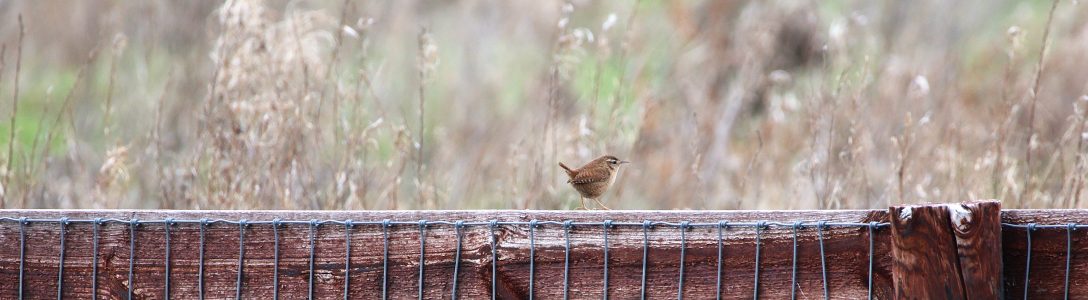
Unfortunately summer didn’t have a slow fade out this year. It was a blink-and-you’ll-miss-it transition into autumn, where I am typing this now from under a blanket while sipping a mug of tea. As a farewell to days baked warm by the sun, we’d like to talk about a bird who thrives among the long, dry grasses of late summer; a year-round resident who you’ll also be able to find in some special fields in winter. This month’s bird is the Reed Bunting (Emberiza schoeniclus), known as Gealóg ghiolcaí as Gaeilge.

After days and days of scorching heat without relief from neither cloud nor rain, the field of long grass before you is a shimmering sea of tawny gold. The wooden fence post beneath your hands exudes warmth, like it could burst into flames. A gentle wind shakes noise out of the reeds — the hollow stems brushing against one another. Leaning forward and squinting, you catch a glimpse of a small shape clinging to a yellow stalk. There is a flash of light in their dark eyes, barely distinguishable in their black face. They have the body of a sparrow but the head isn’t right, burned to a crisp by the relentless sun. From where you’re standing you can barely make out the line of white feathers cascading out the side of their beak. They throw back their head and trill a sweet song; a rich melody against the whispering of the reeds.


Quick thank you to Toy Story 2 for bringing prospectors to the collective consciousness of my generation. Without Stinky Pete I wouldn’t have been introduced to the moustache-beard-sideburn combo that resembles the markings on a reed bunting’s face. Their aptly named moustachial stripe runs from the side of their beak, down to their neck, and wraps around the back of their head. From certain angles they really look quite jowly. And it’s not just the boys, the ladies get to rock the ‘stache too; serving 2000’s fingerstache realness.
These whiskered warblers (note: not actually a member of the warbler family) are such facial hair fanatics, that they can reliably be found in stubble fields come wintertime. Stubble fields are former cereal plant fields whose grain has been harvested but whose short plant stalks have been mixed back into the topsoil, resulting in blunt ends sticking up. This has benefits for the farmer, the field, and the animals living around it.
If the roots of the plants are left intact, they help bind the soil against erosion and prevent important nitrates from leeching away. When the soil is agitated by tilling the stalks in, it encourages the dormant seeds of weeds to germinate, so they don’t make a surprise appearance later in the actual growing season. A farmer can then pluck the plants and have a mostly weed-free field for the crop next year. In the meantime, the weeds grow and produce more seeds, which provide a much needed winter food source for seed-eaters, like reed buntings.


Aside from the stubble fields, we’ve also had luck finding these birds among their namesake reed beds. Wetlands with lots of opportunities to blend in, like brambles and sedges, are a hotspot of bunting activity. Though the seeds in these areas are harder won, they do provide greater opportunities in terms of breeding. Reed buntings are monogamous and will build a nest out of the usual twigs, grass, and reeds, and then line it with softer materials like hair or moss. They build these nests in a bush or tussock of reeds and lay eggs that look like they were painted with a calligraphy brush. When the chicks hatch, both parents take turns bringing them protein-rich insects to help them grow quickly. Young buntings are even less distinguishable from sparrows at that age, so you’ll have to look close to spot that special face stripe.
Buntings and sparrows were actually once formally grouped together, but have since been separated out into their own families. The origin of the name “bunting” is unclear; and the same is true for the flag variety of bunting…so we don’t know that they don’t come from the same source. One commonly accepted theory is that bunt means colourful in German, and they both kinda share that in common. Personally I feel like there’s more to it, so if any etymologists are reading, reach out and we can solve a mystery.


So after being separated out into their own family, who else is in the bunting clan? One member is the yellowhammer, a once well-known and beloved staple of the Irish countryside who has gradually been vanishing; in the last 20 years their population has declined by almost 60%. The reasons are nuanced and mixed, but I wanted to talk about one specific one. If you’ll cast your mind back, I said that stubble fields help weeds germinate early so the farmer can remove them. Well, sometimes they don’t get plucked, they get blasted with herbicide.
Herbicide use has knock-on effects for every member of the ecosystem, including the plants themselves. Teagasc, the Agriculture and Food Development Authority, has in the past few years recorded an increasing number of herbicide resistant plants, which impact farming and are harder to remove. This use of herbicides paired with the shift away from mixed farming practices, like the reduction of cereal crop cultivation, means our bird friends are starved for food and slowly disappearing.


Thankfully, the reed bunting currently has a green conservation status, so for now you can find them anywhere reedy or grassy. Since autumn is a time for planting bulbs and thinking about the garden for next year, I’d humbly ask you to include the modest seed in your plans. Whether that be in a hanging feeder or on a table, it’s a great boost to birds in the colder months who can’t find food in their own habitats. And make sure you check any sparrows who come calling, just in case one has a funny head and a proud old moustache.
Brillant